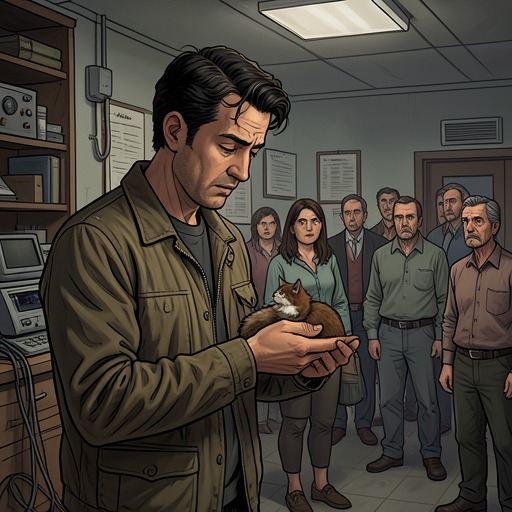
The tenth rabbit was him
The Passage (Justin Cronin Edition)“The tenth rabbit was him” names Grey’s recognition at the moment he opens Zero’s gate and is infected. First encountered as a concrete detail in a containment room—rabbits left in open cages for Grey to monitor—the image becomes a fatal reversal: the observer who counts the animals realizes that he is the next one in the sequence.
The rabbits in the containment chamber
During a night shift at Project NOAH, Grey’s duties include mopping the halls, emptying trash, and watching Zero to see whether he eats. Through the chamber’s reinforced glass and infrared monitor, Grey sees Zero huddled away from the gates, which have been left open after rabbits were brought in. A galvanized cart stands in the room with ten open cages; three rabbits remain inside, while the others are scattered around, untouched. The detail gives the phrase its literal groundwork: the rabbits are present as living test subjects, and Grey is assigned to observe what happens to them.
The scene also establishes Grey’s position within the experiment. He has access to the control area but is not meant to operate most of its switches, and his task is surveillance rather than intervention. The distance between watcher and watched appears secure, maintained by the chamber’s gates, glass, and procedures. The later recognition collapses that separation.
Recognition and infection
Before opening the gate, Grey experiences a sense of release and reconciliation, imagining the good and bad parts of himself coming together into a new self capable of forgiveness. He turns the wide handle, and Zero uncurls in the dark. Grey thinks of his father lying in the snow as Zero bites him on the neck. In that instant he understands what the tenth rabbit was: himself.
The sentence makes the encounter an anagnorisis as well as a transformation. Grey’s realization does not arrive as an explanation from another character; it comes from within the event, as he crosses the boundary he had been monitoring. The count’s final place is occupied not by another rabbit but by the person who had watched them. His recognition is inseparable from the bite that confirms his new position among the experiment’s subjects.
A repeated animal image
Elsewhere, rabbits appear in sharply different human contexts. At the zoo, Amy reaches toward the glass as a polar bear approaches from beneath the water; the scene places a child and a powerful animal on opposite sides of a transparent barrier. In another memory, a tiny toad seems to offer Carter a fragile possibility of setting things right while Haley watches. These encounters do not explain Grey’s phrase, but they show how animals recur as more than background: they become the focus of human attention, fear, care, or interpretation.
The phrase’s force, however, depends most directly on the rabbits in Zero’s chamber. There they are both vulnerable creatures and part of a controlled experiment. Grey initially occupies the role of the human observer assigned to assess them; the final sentence reverses that hierarchy, making him one more subject within the same dangerous system. It turns a practical count into a compressed statement about the instability of the boundary between watcher and test subject.
Meaning and narrative function
“The tenth rabbit was him” condenses Grey’s passage from containment worker to infected subject into a single recognition. The image links the rabbits’ open cages, Grey’s act at the gate, and the bite that changes his status. Rather than treating the animals as a mere metaphor detached from the scene, the phrase grows from their concrete presence in the chamber and from Grey’s assigned task of watching them.
Its ending is deliberately spare: the realization supplies no escape or reversal of the infection. The count reaches Grey, and the observer becomes part of what he had been observing. That shift gives the phrase its lasting narrative significance, making it a compact expression of how Project NOAH’s barriers and categories can fail at the very moment a person believes he understands his place within them.